How to Build Topical Authority for AI Search
Topical authority for AI search means building a connected body of content around a specific subject so that AI systems like ChatGPT, Perplexity, Google AI Overviews, Gemini, and Claude can consistently recognize your site as a credible source. A website that covers one subject deeply and consistently is more likely to be retrieved and cited than one that publishes isolated articles across unrelated topics. This is one of the most practical things a publisher can do to improve AI search visibility without changing a single line of technical code.
That matters because AI search works differently from traditional search. When someone asks ChatGPT or Perplexity a question, the system is not only looking for a page that matches a keyword. It is trying to identify which sources seem trustworthy enough to help form a useful answer. A site with strong topical coverage sends a clearer signal than a site with scattered content.
Understanding how AI search engines choose sources is the starting point. From there, topical authority becomes one of the most reliable ways to make your content easier to retrieve and cite.
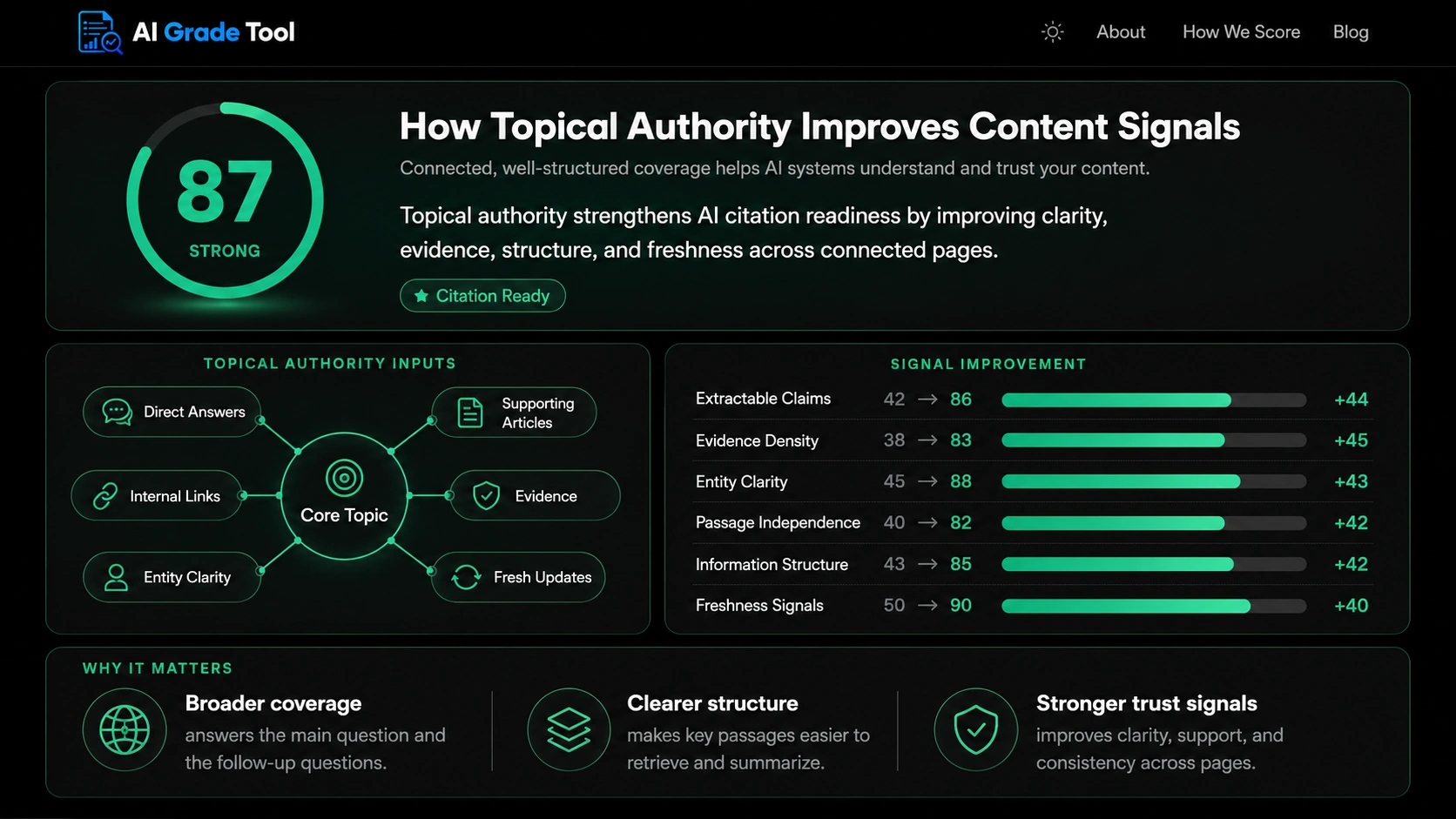 How topical authority strengthens AI citation signals — connected coverage improves extractable claims, evidence density, entity clarity, and freshness across your site.
Why topical authority matters more in AI search
AI search engines are built around synthesis. They do not simply show ten blue links and leave the reader to compare them. They often produce a direct answer, then attach citations or source links to support that answer.
That changes the role of your content.
In traditional SEO, a page can win visibility by matching a search query well enough. In AI search, the page may need to do more than match. It may need to fit into a larger body of evidence. It may need to explain the topic clearly, use consistent terminology, support its claims, and sit within a website that looks like it actually knows the space.
This is why thin content clusters rarely work as well as people hope. Publishing ten shallow articles around a topic is not the same as building authority. AI systems are getting better at recognizing whether a site has real coverage or just a collection of keyword-shaped pages.
A site with topical authority tends to answer the obvious questions, the second-order questions, and the uncomfortable questions. It explains where people get confused. It compares similar concepts. It updates old assumptions. It creates enough context around a subject that a reader can move from beginner understanding to practical decision-making without leaving the site every two minutes.
That kind of depth is useful to humans. It also gives AI systems more material to work with.
The mistake most sites make
The common mistake is treating topical authority like a content calendar problem.
A team picks a topic, opens a keyword tool, exports a list of phrases, and starts assigning articles. On paper, it looks organized. There are titles, target keywords, estimated search volumes, and publishing dates.
But the end result often feels flat. Every article sounds like it was written to fill a slot. The site has coverage, but not perspective. It has definitions, but not judgment. It has headings, but not much actual thinking.
That matters because AI search does not reward a page simply because it exists. A page still has to be useful. It has to contain information that can be extracted, summarized, and trusted. If every page on the site reads like a generic overview, there is not much reason for an AI system to choose it over a stronger source.
A better way to think about topical authority is not, “How many articles can we publish around this keyword cluster?” It is, “If someone wanted to understand this subject properly, what would they need to know, and where are the gaps in the current conversation?”
That question produces better content. It also produces a stronger site.
Start with the topic, not the keyword
Keywords still matter, but they should not be the starting point. A keyword is usually a surface-level expression of a deeper problem.
For example, someone searching “AI citations” may be asking several different things. They may want to know how ChatGPT chooses sources. They may want to know whether Google AI Overviews works the same way. They may be wondering why their website is not being cited. They may be trying to understand whether schema markup helps. They may be asking whether backlinks matter in AI search.
Those are different questions, even if they sit close together.
A site that wants topical authority around AI search visibility should not only publish one article called “What Are AI Citations?” and move on. It should build a connected library of content that handles the real concerns underneath the phrase.
This is how topic clusters become useful. Not because they satisfy an SEO checklist, but because they create a meaningful body of work.
Build around questions people actually ask
One of the simplest ways to build topical authority is to listen carefully to the questions people keep asking after they read your content.
A strong topic cluster usually has layers. There are beginner questions, comparison questions, technical questions, trust questions, and “what should I do next?” questions. If your site only answers beginner questions, it will feel incomplete. If it only answers advanced questions, it may be hard for new readers to enter.
AI search tends to reward content that is easy to understand and useful in context. That does not mean every article should be simplistic. It means your content should reduce confusion instead of adding to it.
For AI search visibility, this is especially important because the subject is still new enough that many readers are working with half-formed assumptions. Some people think AI citations work exactly like SEO rankings. Others think they are completely random. Some believe schema markup alone will solve the problem. Others think only massive brands can be cited.
Good content meets people inside that uncertainty and helps them think more clearly. That is the real work of topical authority.
Create pages that support each other
A single article can answer a question. A strong content library can build trust.
This is where internal linking matters. Internal links should not be dropped into articles just because a plugin says you need more of them. They should help readers move naturally from one related idea to another.
If an article explains topical authority, it may naturally connect to GEO vs SEO because the reader needs to understand how AI search optimization differs from traditional search optimization. It may connect to how to get cited by AI search engines because topical authority is one of the signals that shapes source selection. It may connect to why AI search engines ignore some websites because weak topical coverage is often part of the problem.
Those internal links create pathways. They show readers that the site has a broader point of view. They also help search systems understand how your content fits together.
The goal is not to trap users inside your site. The goal is to make the next useful step obvious.
Depth beats volume
There is a temptation to build topical authority by publishing as much as possible. That can work if the quality stays high, but most teams cannot maintain depth at high volume.
AI search creates a particular problem for low-quality scale. If your content is repetitive, generic, or thin, it may technically increase your page count while weakening the overall impression of the site. A large library of forgettable content is not authority. It is clutter.
A better approach is to build slowly and deliberately. Choose a narrow topic area. Publish the pages that genuinely need to exist. Revisit them. Improve them. Add examples. Remove outdated sections. Connect them to related articles. Make the site more useful over time.
For AI citation readiness, this matters because your content is not being judged only in isolation. The broader site context can influence whether a page feels credible, current, and worth using as a source.
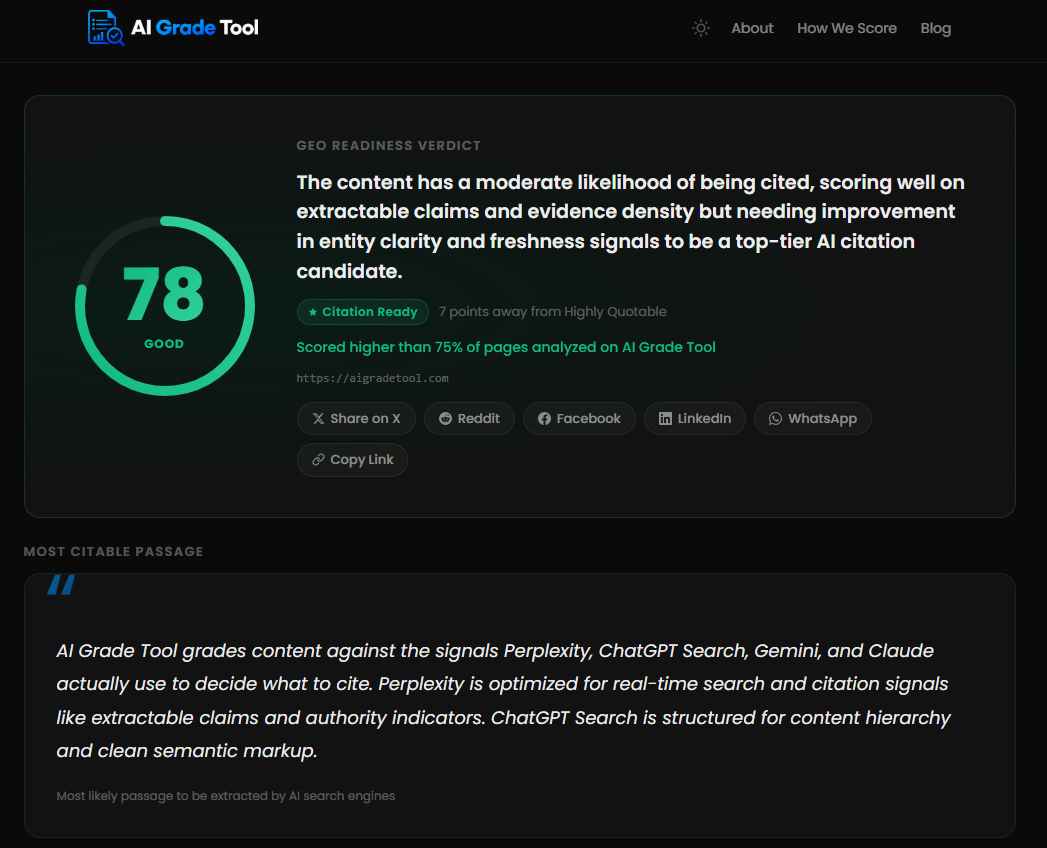 A content page graded 78/100 on AI Grade Tool — strong on extractable claims and evidence density, with entity clarity and freshness identified as the top improvement opportunities.
This is one reason tools like AI Grade Tool exist — to help publishers see whether individual pages are structured clearly enough to be retrieved and cited. The score above reflects a page with strong extractable claims and evidence density, but with room to improve on entity clarity and freshness signals. Those are exactly the gaps that topical authority work tends to close over time.
Authority comes from consistency
Topical authority is partly about coverage, but it is also about consistency.
Do you use terms the same way across your site? Do your articles agree with each other? Do you update older pages when your understanding changes? Do you explain your reasoning, or do you simply repeat common advice?
These things add up. A site that consistently explains a subject well becomes easier to trust. A site that jumps from topic to topic, changes terminology constantly, and publishes shallow summaries is harder to understand.
For AI search, consistency helps because the systems retrieving and summarizing content need clear signals. If your site has a coherent body of work around a topic, each article reinforces the others. If your site is scattered, every page has to work harder on its own.
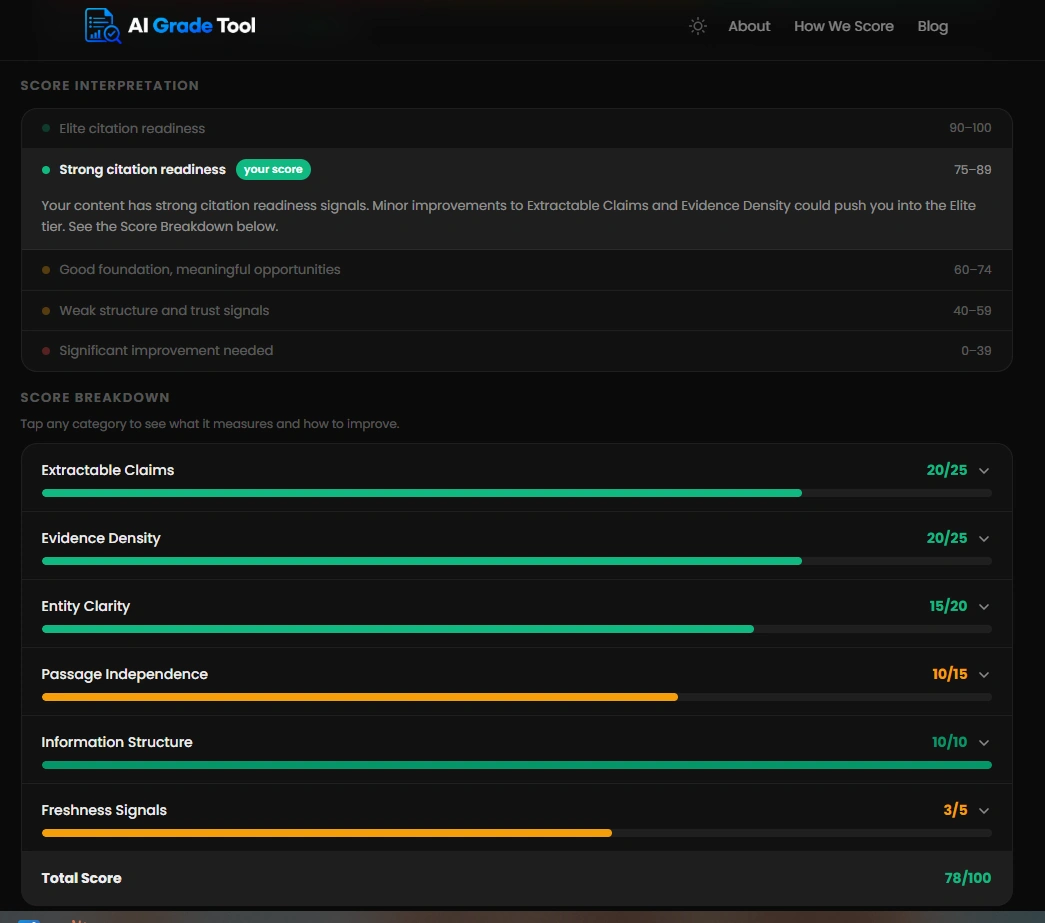 Score breakdown showing Information Structure at full marks and Passage Independence as the key gap — exactly the signals that a stronger topical cluster helps improve over time.
The score breakdown above illustrates exactly how topical authority shows up in measurable signals. Information Structure scores full marks when content is clearly organized — a direct result of consistent editorial standards across a site. Freshness Signals and Passage Independence are the areas most improved by building a connected, regularly updated content cluster rather than isolated pages.
Questions People Still Ask
Can a new website build topical authority for AI search?
Yes. A new website can build topical authority, especially if it focuses on a narrow subject and covers it better than broader competitors. New sites often struggle when they try to look authoritative across too many topics too quickly.
How many articles do you need to build topical authority?
There is no fixed number. Ten strong, connected articles can be more useful than fifty shallow ones. The better question is whether your site answers the main questions someone would reasonably ask about the topic.
Does topical authority help with AI citations?
It appears to help, although no AI search engine publishes a simple formula for citation selection. A site with strong topical coverage gives AI systems more relevant material to retrieve and more context for understanding why the source matters.
Should every article target a keyword?
Every article should have a clear purpose, but not every article needs to be built around a single keyword. Some of the best authority-building content answers comparison questions, explains misconceptions, or fills gaps that keyword tools do not capture well.
Is topical authority the same as domain authority?
No. Domain authority usually refers to the perceived strength of a domain, often influenced by links and reputation. Topical authority is more specific — it is about whether a site appears knowledgeable and useful within a particular subject area.
The slower path is usually the stronger one
Building topical authority is not a trick. It is not a schema setting, a content template, or a publishing sprint. It is the cumulative effect of useful work.
For AI search, that may become even more important over time. As more content floods the web, AI systems will need to decide which sources are worth using. Sites that explain their subject clearly, consistently, and deeply will have a better chance of being understood and cited.
That does not guarantee citations. Nothing does. But it gives your content a stronger foundation. And in AI search, foundation matters.
If you want to see how well a specific page is positioned for AI citation today, grade your content with AI Grade Tool — it scores your page against the signals AI search engines use to evaluate sources.