Do AI Search Engines Use Backlinks?
AI search engines do use backlinks, but not the way traditional SEO assumes. Backlinks help establish trust and discoverability — a site referenced by credible sources carries more weight than one that exists in isolation. But backlinks alone cannot get a page cited by ChatGPT, Perplexity, or Google AI Overviews. The reason is that AI systems add a second filter that traditional search rankings largely ignore: content usability. A page on a weak domain that answers a question clearly and directly is often more useful to an AI system than a vague, bloated page on a highly authoritative site. Authority and usability both matter — but they are not the same thing, and conflating them is one of the most common mistakes publishers make when trying to improve AI search visibility.
Backlinks didn’t stop mattering
For years, backlinks were treated almost like currency. The logic was familiar: more high-quality links meant stronger authority, stronger authority improved rankings, and stronger rankings improved visibility. That basic idea didn’t suddenly become false because AI search showed up.
Authority still matters. Trust still matters. A site referenced by other credible sources will almost always look stronger than one that exists in isolation. That’s not controversial.
What has changed is the idea that authority alone solves the whole visibility problem. AI systems aren’t simply recreating traditional search rankings in a chatbot wrapper — there’s another filter now: usability.
The thing backlinks can’t fix
Here’s where it gets interesting. Imagine two articles answering the same question.
One lives on a massive domain with years of authority and a strong backlink profile — but the article itself is vague, bloated, and takes forever to get to the point. The other lives on a smaller site with far less authority, but the content is clear, specific, and answers the question directly.
Which one is easier for an AI system to quote?
That’s not a trick question. Backlinks may help establish trust and discoverability, but if the actual content is hard to use, that’s a separate problem authority can’t solve. A system trying to lift a clean answer will reach for the usable one.
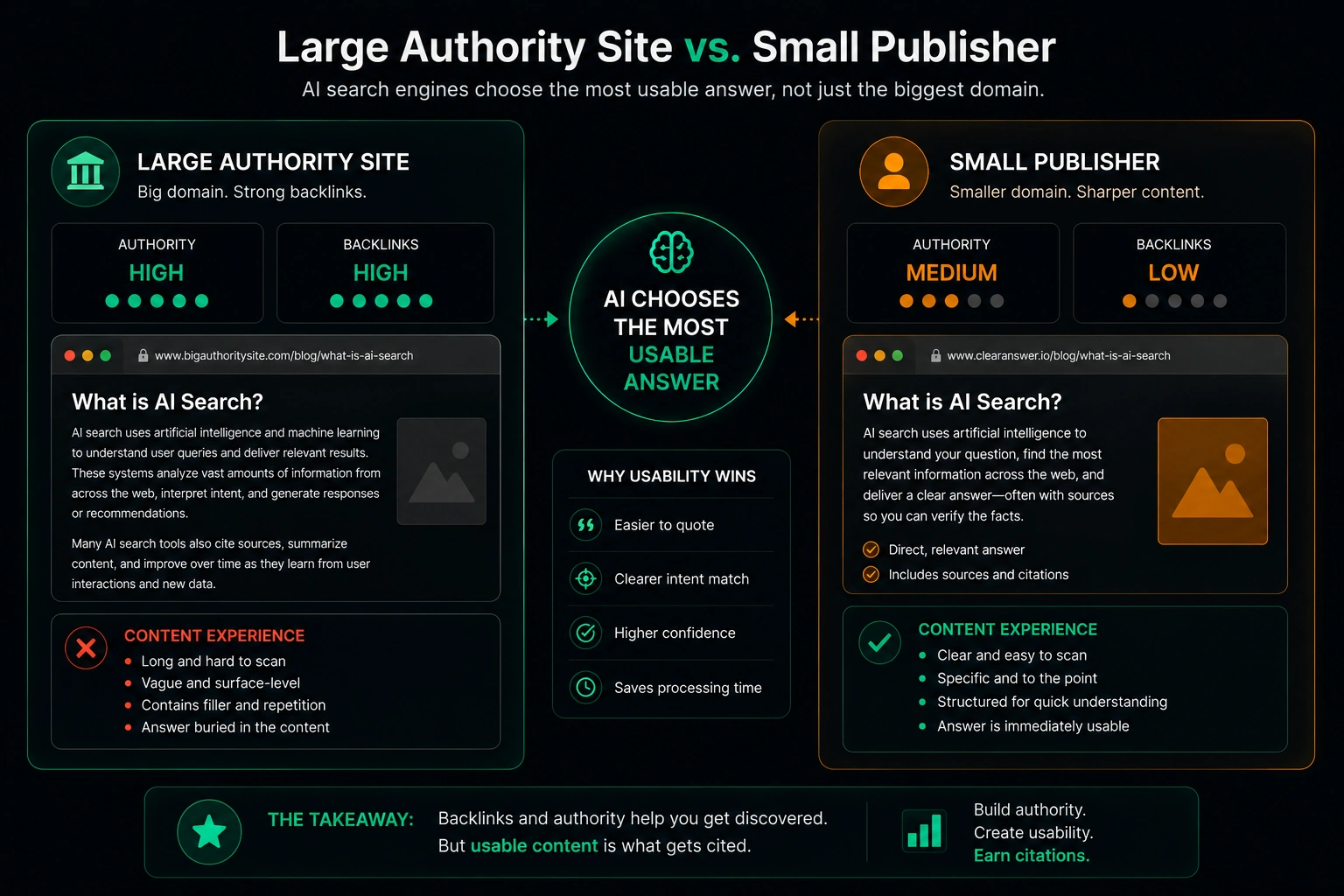 A large authority site and a smaller publisher compared on AI citation readiness — content usability can outweigh domain authority when AI systems are selecting sources to cite.
The oversimplified debate
This is why the conversation around backlinks and AI search usually gets flattened into one of two wrong positions.
Some people have gone too far and started acting like backlinks are dead. That’s nonsense. Others still behave as though backlinks are the primary answer to everything. That’s outdated too.
The realistic position sits in the middle: backlinks still help because authority still matters, but AI search visibility depends on more than authority. It depends on whether the content itself is genuinely usable — which means clarity, specificity, trust signals, structure, and freshness all carry weight. If your content is hard to quote, hard to interpret, or packed with filler, authority only carries you so far.
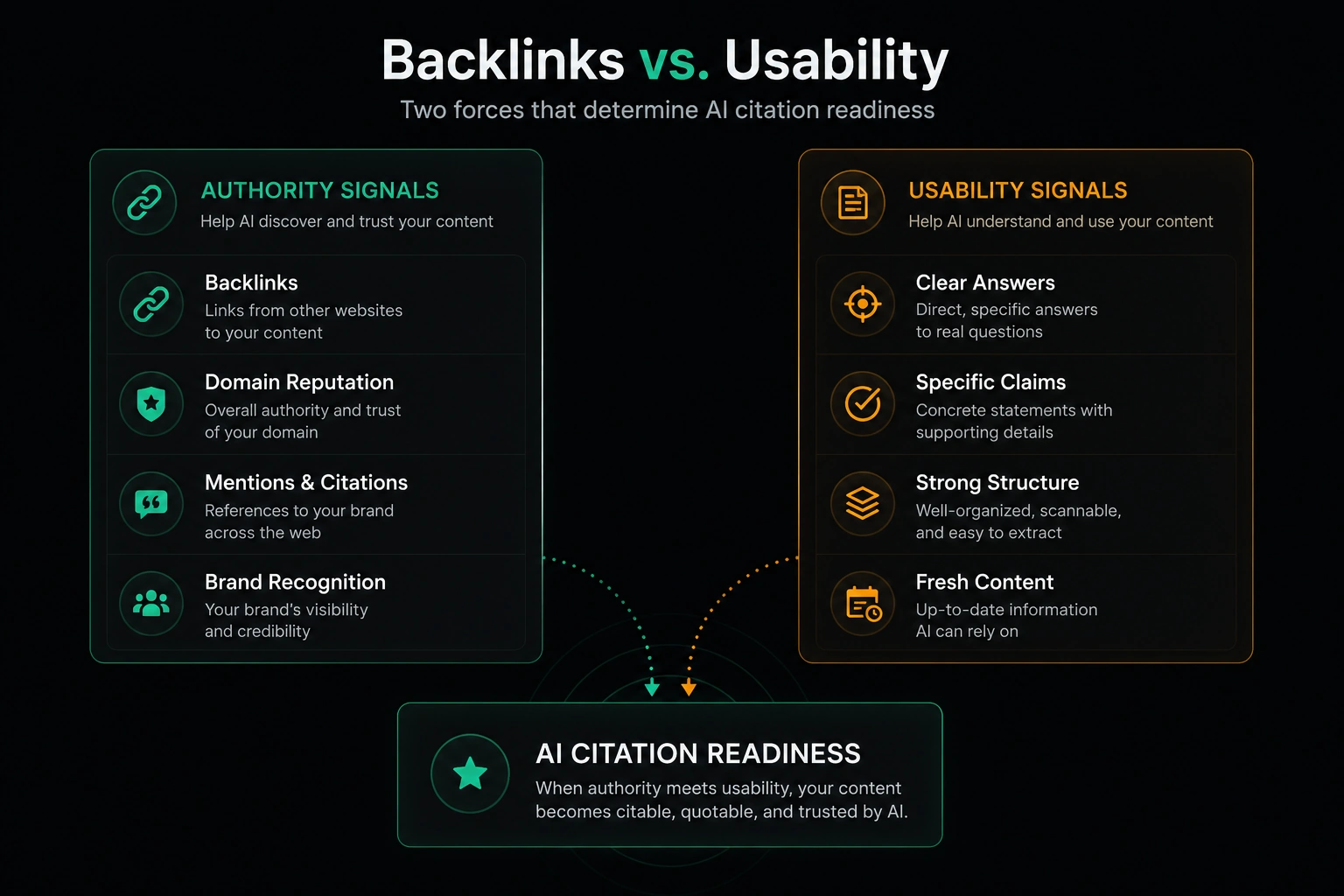 Backlinks versus content usability as AI citation signals — authority helps with trust and discoverability, but usability factors like extractable claims, structure, and evidence density determine whether a page actually gets cited.
Why this favors smaller publishers
This is one reason smaller publishers should pay attention right now. Traditional search often felt brutally tilted toward larger sites — more links, more domain history, more institutional trust. Those advantages still exist, and nobody should pretend otherwise.
But AI citation environments create more room for execution quality to matter. A smaller publisher with sharper content can absolutely outperform a larger one that leans too heavily on lazy authority. That’s a meaningful shift.
Understanding what types of content get cited most often by AI gives smaller publishers a clear playbook — one that doesn’t require a massive domain or years of link building to execute.
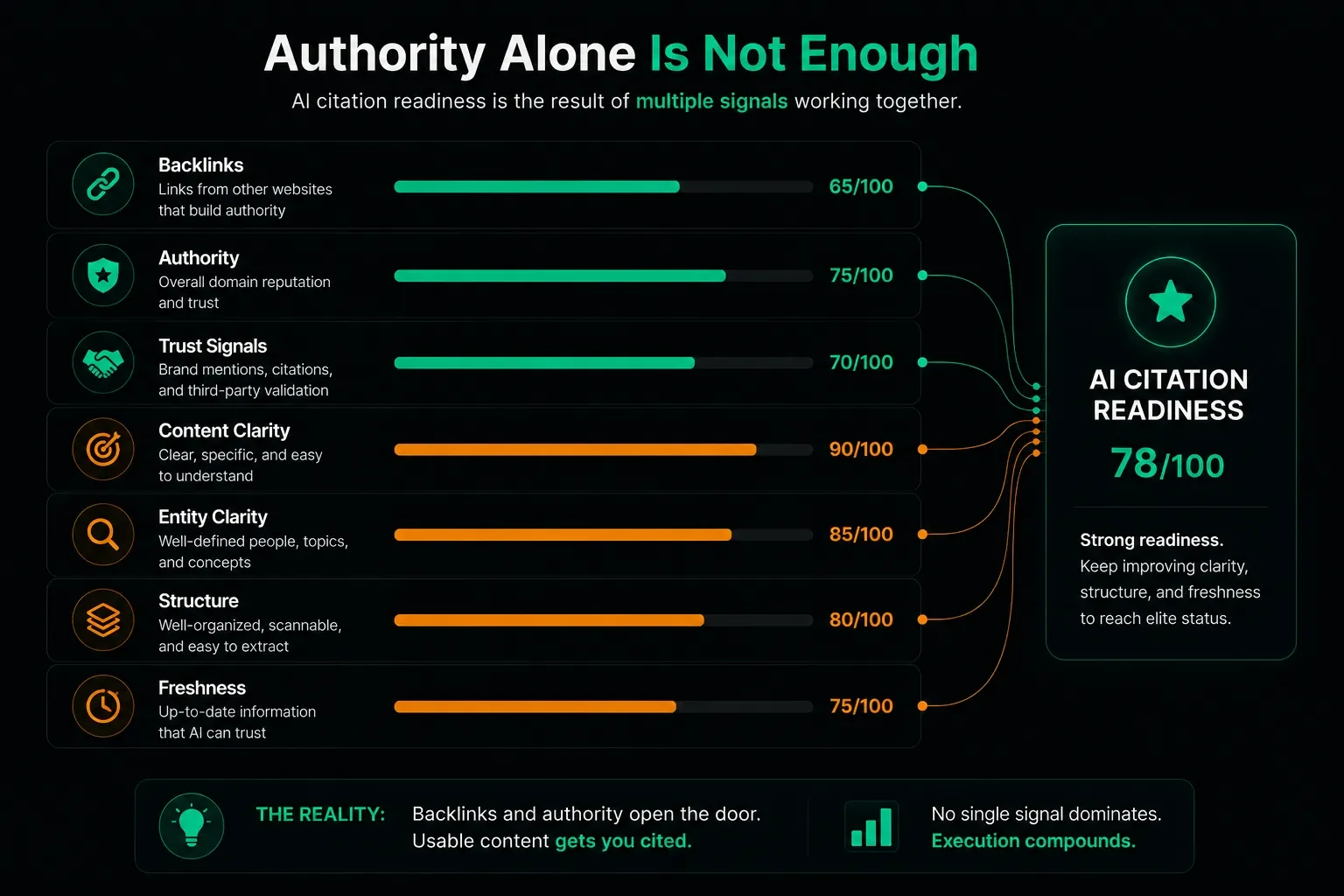 Authority alone is not enough for AI citation readiness — the signals that drive citations include extractable claims, evidence density, entity clarity, and information structure, all of which depend on content quality rather than link counts.
Does the weight of backlinks vary by platform?
Probably, yes. Google AI Overviews likely remain more influenced by traditional authority ecosystems than something like Perplexity, simply because Google’s AI layer sits on top of decades of existing search infrastructure. Perplexity often feels more aggressively citation-focused, which can create openings for highly quotable content regardless of domain size. The other engines sit somewhere along their own versions of that spectrum.
But trying to reverse-engineer the exact weighting on each platform is a losing game — nobody outside those companies knows it, and it changes constantly. This is also why Google AI Overview and ChatGPT cite websites differently — the role backlinks play shifts depending on which system is doing the retrieving.
The practical takeaway
It’s simpler than reverse-engineering anything: backlinks still matter, they’re just no longer the whole story.
If your AI search strategy is “build links and hope,” you’re missing too much. If your strategy is “authority doesn’t matter anymore,” you’re being naive. The stronger approach combines both — build authority, but also publish content that’s genuinely easier to trust, understand, and surface. That’s where the leverage is now.
And honestly, that’s a healthier direction than pretending backlinks alone should decide everything forever.
Curious how usable your content actually is, separate from your backlink profile? Check it with AI Grade Tool — paste a URL or your text and get a citation-readiness score, your most quotable passage, and your biggest gaps. It’s free.