What Is an AI Visibility Score?
An AI visibility score is a measure of how likely your content is to be cited by AI search engines like ChatGPT, Perplexity, Google AI Overviews, Gemini, and Claude. Unlike a traditional SEO ranking, which tells you where a page appears in a list of search results, an AI visibility score tells you whether your content is structured and written in a way that makes AI systems want to use it as a source. A page can rank on the first page of Google and score poorly on AI visibility. A page can have a weak backlink profile and score strongly on AI visibility. The two measures are related but not the same — and understanding the difference is one of the most important things a publisher can do in 2026.
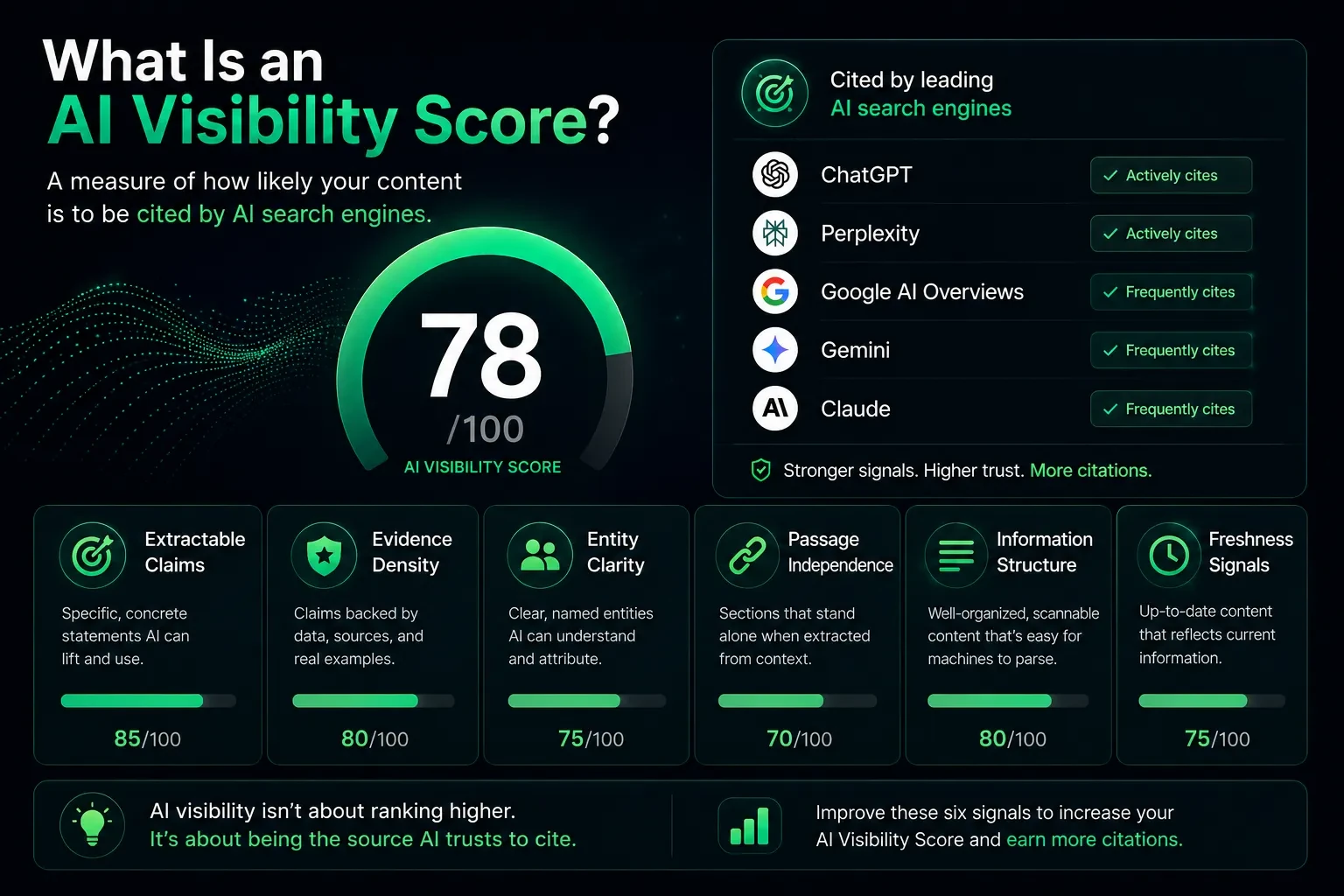 An AI visibility score measures how citation-ready your content is — not just whether it ranks, but whether AI search engines like ChatGPT, Perplexity, and Google AI Overviews would use it as a source.
Why AI visibility is different from search rankings
Traditional search rankings are influenced by hundreds of signals — backlinks, domain authority, page speed, click-through rate, and keyword relevance among them. These signals help Google decide which pages to show in response to a query.
AI search works differently. When someone asks ChatGPT a question, the system is not ranking pages. It is generating an answer and selecting sources to support that answer. The question it is asking about your content is not “does this page rank for this keyword?” It is “can I extract a clear, trustworthy, self-contained answer from this page?”
That shift changes which content signals matter. A page full of vague brand messaging may rank on Google but never appear in a ChatGPT response. A page with sharp, specific, well-structured answers may be cited regularly by Perplexity and Google AI Overviews even without a strong backlink profile.
This is the core insight behind AI visibility as a distinct metric — and why GEO (Generative Engine Optimization) differs from traditional SEO.
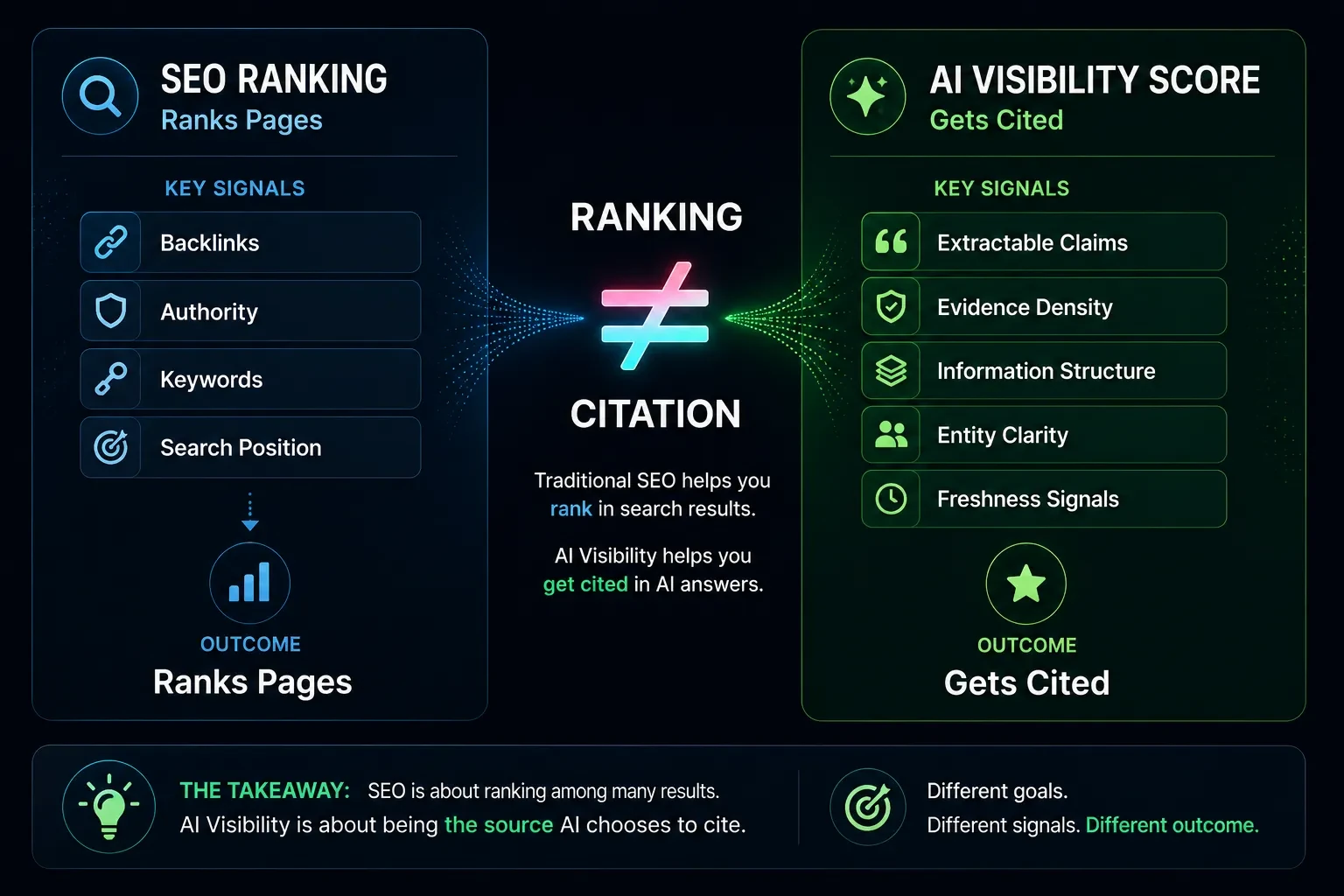 SEO rankings and AI visibility scores measure different things — traditional search rewards authority and keyword relevance, while AI citation readiness rewards clarity, extractability, and evidence.
What an AI visibility score actually measures
A well-constructed AI visibility score evaluates the content signals that AI search engines use when selecting sources. These signals fall into six categories:
Extractable claims — Does the content make specific, concrete statements that can be lifted and used in an AI-generated answer? Vague content scores poorly here. Precise, verifiable claims score well.
Evidence density — Are claims supported by specific details — named sources, data points, examples, or demonstrations of expertise? AI systems need content they can trust, and trust requires evidence.
Entity clarity — Does the content clearly name the people, products, companies, and concepts it discusses? Content that refers to “they” and “it” instead of named entities is harder for AI systems to parse and attribute correctly.
Passage independence — Can individual paragraphs or sections stand alone when pulled out of context? AI systems often extract passages rather than entire pages. A passage that only makes sense in context of the full article is harder to cite.
Information structure — Is the content organized in a way that is easy for machines to parse? Clear headings, logical flow, and scannable formatting all help AI systems identify what a page is actually about.
Freshness signals — Where recency matters, does the content signal that it reflects current information? For fast-moving topics, outdated content is risky for AI systems to cite.
AI Grade Tool generates an AI visibility score out of 100 by evaluating all six of these signals. The result is a practical diagnostic — not a vanity metric — that shows exactly which signals are strong and which are holding your content back.
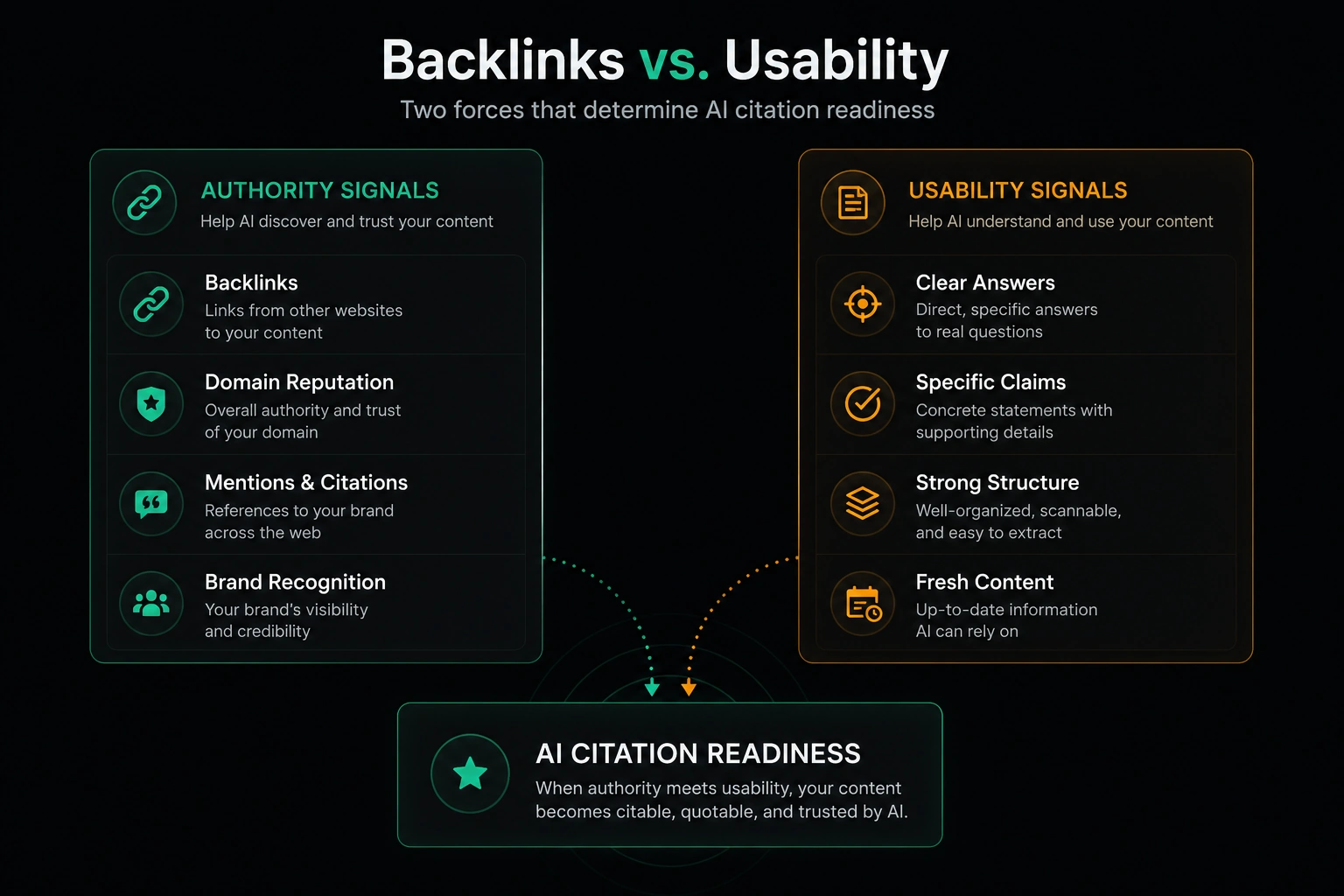 Authority signals like backlinks help AI systems discover and trust your content — but usability signals like extractable claims, clear structure, and evidence density determine whether it actually gets cited.
How Google AI Overviews use these signals
Google AI Overviews sit inside Google Search and are shaped by Google’s existing crawling and quality systems — which means traditional search fundamentals still matter. But AI Overviews add a layer that pure SEO rankings do not account for: the ability to extract and synthesize content into a direct answer.
A page that ranks well in Google but buries its main point under six paragraphs of scene-setting is less useful for an AI Overview than a page that answers the question in the first two sentences. A page with strong schema markup and clear entity definition is easier for Google’s systems to understand and cite. A page that is updated regularly for fast-moving topics is more trustworthy than one that has not been touched in two years.
This is why schema markup can help AI citations — not because it guarantees them, but because it gives Google’s systems more structured context to work with. And it is why building topical authority matters for AI Overview visibility: a site that consistently covers a subject gives Google more reason to treat it as a reliable source.
Improving your AI visibility score addresses the content signals that Google AI Overviews evaluate — answer clarity, extractability, evidence, and freshness. It will not guarantee placement, but it directly improves your odds.
How ChatGPT and Perplexity use these signals
ChatGPT and Perplexity are conversational AI systems rather than search engines with a results page. Their retrieval behavior is shaped by the answer they are trying to construct, which means content that answers natural-language questions clearly tends to perform better than content optimized purely for compact keyword phrases.
ChatGPT can cite your website — but whether it does depends heavily on whether individual passages in your content are clear enough to use directly in a generated response. A long article that buries its most useful claim in paragraph fourteen is harder to cite than a shorter article that leads with the answer.
Perplexity is generally more aggressive about citing sources and tends to favor content that is highly quotable and specific. A strong AI visibility score — one that reflects high extractable claims and evidence density — correlates well with Perplexity citation performance.
The same underlying signals matter across both platforms. What types of content get cited most often by AI comes down to clarity, structure, specificity, and trust — regardless of which AI system is doing the retrieving.
How to check and improve your AI visibility score
The fastest way to check your AI visibility score is to paste a URL or your content text into AI Grade Tool. The tool evaluates all six citation signals and returns a score out of 100 in about 10 seconds. You get your overall score, your most citable passage, a breakdown of which signals are strong and which are weak, and — for pages scoring below 70 — a rewritten opening optimized for citation.
The practical improvements that move an AI visibility score tend to fall into a few categories:
Lead with the answer. Content that answers the question in the first paragraph is more extractable than content that builds to an answer over multiple sections. AI systems often pull from the beginning of a page, and the opening paragraph is one of the highest-leverage places to improve.
Make claims specific. “Studies show that content with clear structure performs better” is weak. “Pages with clear H2 headings and short paragraphs score significantly higher on citation readiness” is citable. The difference is specificity.
Name your entities. Replace pronouns with named subjects wherever possible. Instead of “they found that it improved results,” write “the research team found that structured content improved citation rates.”
Update content that covers fast-moving topics. Do AI search engines prefer fresh content? Not universally — but for topics that change frequently, freshness is a real factor. Review fast-moving pages regularly and update outdated claims.
Build topical coverage. A single well-scored page is useful. A site with a dozen strong, connected pages on a subject gives AI systems more reason to treat it as an authoritative source. Each page reinforces the others.
Questions People Still Ask
Is an AI visibility score the same as a GEO score?
Essentially yes — both measure how well content is positioned to be cited by AI search engines. GEO (Generative Engine Optimization) is the practice; an AI visibility score is the metric that tracks how well you are doing it.
Can a high AI visibility score guarantee Google AI Overview placement?
No. Google AI Overview placement also depends on query relevance, domain authority, and how competitive the source pool is for a given topic. But improving your AI visibility score directly addresses the content signals that Google AI Overviews evaluate — and that is the most actionable thing a publisher can control.
Does improving AI visibility hurt traditional SEO?
No. The signals that improve AI visibility — clearer writing, stronger structure, more specific claims, better internal linking — are also good for traditional SEO. The two are complementary. A page optimized for AI citation readiness is generally a better page for human readers too.
How often should I check my AI visibility score?
For fast-moving topics, checking after each significant update is useful. For stable evergreen content, checking every few months is sufficient. The most valuable use of the score is as a before-and-after improvement guide — grade a page, make improvements, grade it again, and track whether the specific signal gaps have closed.
Which AI search engines does the score apply to?
The scoring rubric is calibrated for the citation patterns shared across ChatGPT Search, Perplexity, Google AI Overviews, Gemini, and Claude. These platforms share core citation criteria, so a strong AI visibility score should translate well across all of them — though each platform has its own retrieval behavior and no score can guarantee placement on any specific one.
The practical takeaway
An AI visibility score tells you something traditional SEO metrics cannot: whether your content is built to be cited, not just ranked. As AI search becomes a larger share of how people find information, that distinction matters more every month.
The publishers who will perform best in AI search are not necessarily the ones with the biggest domains or the most backlinks. They are the ones whose content is clearest, most specific, and most useful for the systems trying to construct answers.
Check your AI visibility score at AI Grade Tool — it takes 10 seconds and shows you exactly where your content stands.