Does Google AI Overview Cite Websites the Same Way ChatGPT Does?
Google AI Overview and ChatGPT do not cite websites the same way. Google AI Overview operates inside Google Search and is shaped by Google’s existing crawling, indexing, and quality systems, which means traditional search fundamentals still influence which sources get cited. ChatGPT operates inside a conversational interface where queries are often longer and more natural, which means content that answers questions in plain explanatory language may have a distinct advantage. A publisher trying to improve visibility in both systems needs to understand that difference — not treat all AI citations as a single optimization problem.
This distinction matters practically. A page can rank well in Google and not appear in a Google AI Overview. A page cited by ChatGPT may not appear in Perplexity for the same query. Understanding how AI search engines choose sources is the foundation — and recognizing that each platform has its own retrieval context is the next step.
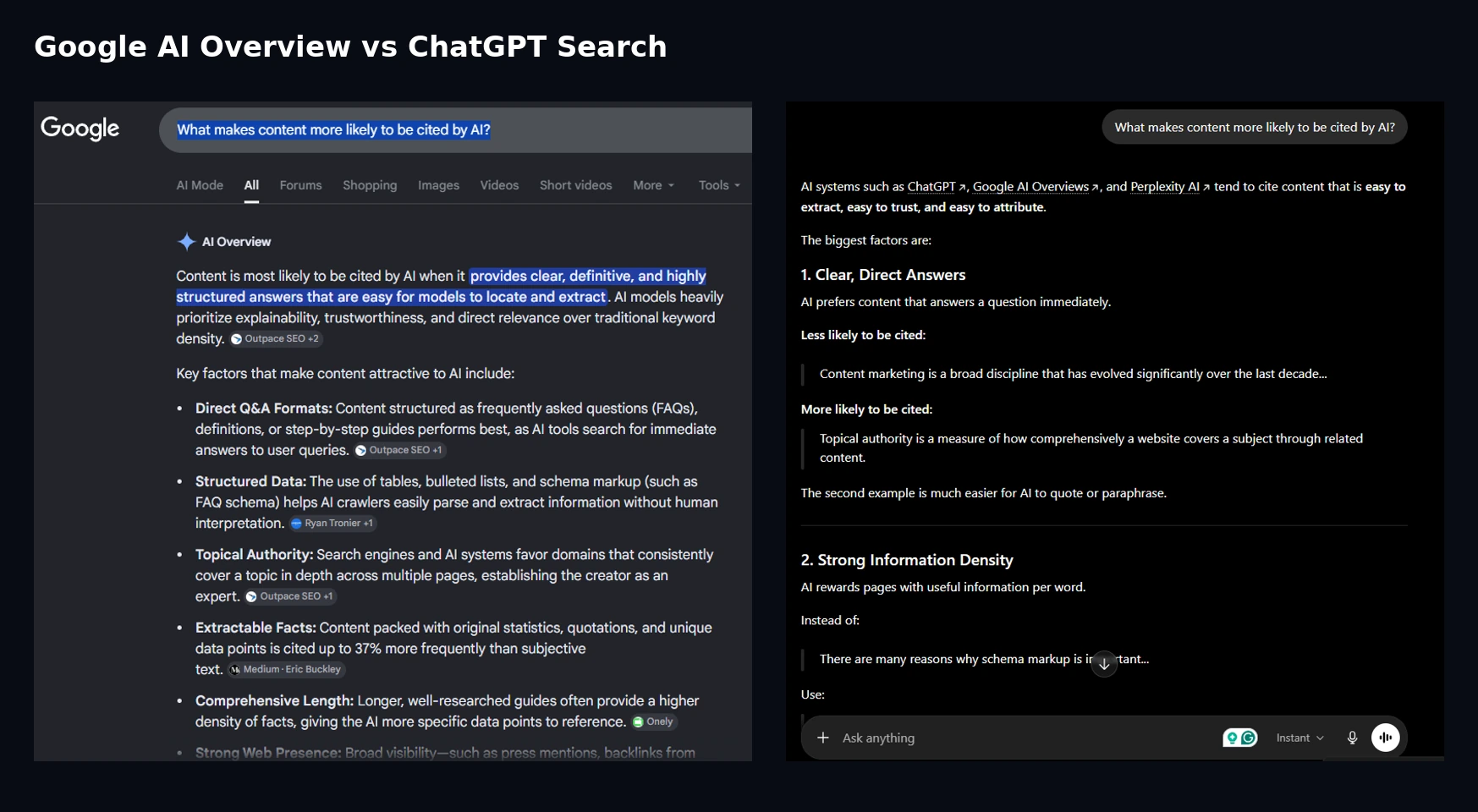 Google AI Overview and ChatGPT Search compared side by side — two AI systems that both cite sources but use different retrieval contexts, interfaces, and source-selection signals.
Google AI Overview starts inside Google Search
Google AI Overview appears inside Google Search. That matters more than people realize.
The user is still searching on Google. The query enters Google’s search environment. The AI Overview is part of a broader results page that may also include organic results, ads, videos, local packs, shopping results, news results, or other search features depending on the query.
That means Google AI Overview exists inside a mature search ecosystem. Google already has crawling, indexing, ranking, spam detection, quality systems, and an enormous understanding of the web. AI Overviews are not floating separately from that world.
For publishers, this means traditional search fundamentals still matter. Crawlability matters. Indexability matters. Helpful content matters. Internal linking, site structure, and content quality still matter. This is also why schema markup and site structure play a role — they give Google’s systems more context to work with.
But that does not mean Google AI Overview simply cites the top organic result. AI Overviews may draw on sources that overlap with organic rankings, but source selection can differ. A page can rank well and not be cited. A page can be cited even if it is not the most obvious traditional ranking result. The AI-generated answer may need sources that support particular claims, not just pages that rank for the overall query.
So the relationship between SEO and AI Overview visibility is close, but not identical. The difference between GEO and SEO is precisely this gap.
ChatGPT works from a conversational search context
ChatGPT is different because the user is usually inside a conversation, not a traditional search results page.
A user may ask a question, refine it, add constraints, ask for a comparison, request sources, or move from one topic to another. ChatGPT can decide when search is needed, and when available, it can provide links or cited sources that support the response.
This creates a different source environment. The query may be more conversational than a Google search. The user may not type “best AI citation readiness tool.” They may ask, “Why isn’t my blog being cited by AI even though it ranks on Google?” That is a richer question. It contains frustration, context, and a practical problem.
For a publisher, this changes the kind of content that may be useful. Pages that answer natural-language questions clearly may have an advantage. Content that explains nuance — like why content isn’t showing up in AI search — may be more useful than content that only targets a compact keyword phrase.
This is one reason articles built around real user questions can matter so much in conversational AI search. They match how people actually ask in this environment.
The citation interface is different
Google AI Overview and ChatGPT also present sources differently.
Google AI Overview is part of a search results page, so its links sit inside a familiar search environment. The user can scan the overview, expand or inspect sources, and continue through Google results.
ChatGPT’s source experience is tied to the generated response. In ChatGPT Search, sources may appear inline or through a sources panel depending on the interface and context. The user is not looking at a normal ranked list in the same way. They are reading an answer and deciding whether to inspect the supporting links.
That difference affects publisher expectations. In Google, a citation may live alongside organic visibility. In ChatGPT, a citation may be part of a conversational answer where the source is used to support a specific statement. The user’s path to the publisher is different.
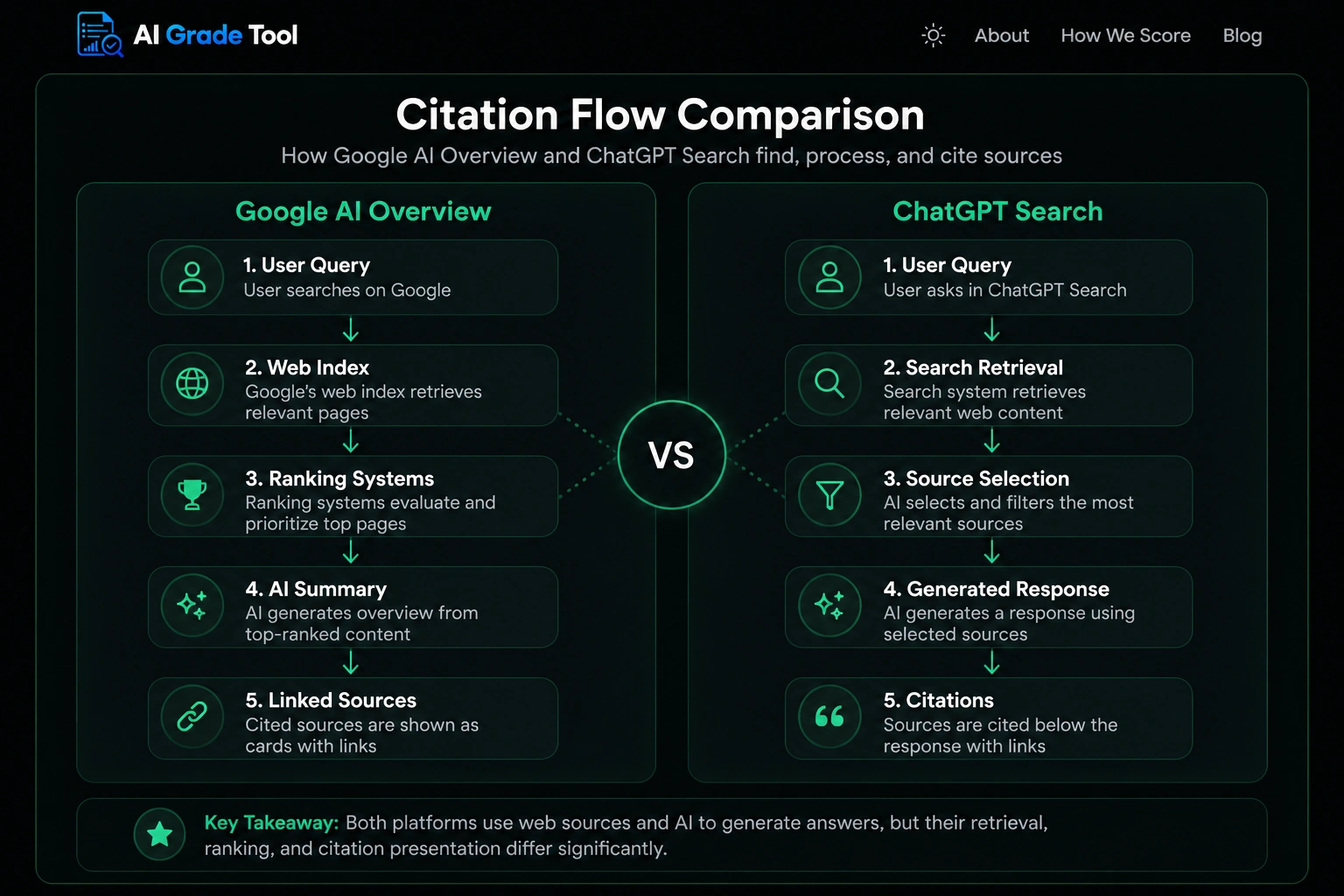 How a query flows through Google AI Overview versus ChatGPT Search — the retrieval path, source context, and user experience differ significantly between the two systems.
This is why measuring AI search visibility is not as simple as checking rankings. A site may be visible in Google Search, cited in Google AI Overviews for some queries, cited in ChatGPT for others, and absent from Perplexity or Gemini for similar prompts.
Google may reward search-native signals more strongly
Because Google AI Overview is connected to Google Search, it is reasonable to expect Google’s existing search systems to play an important role.
A site that is difficult for Google to crawl, poorly structured, thin on substance, or overloaded with generic content will struggle before AI Overview is even part of the conversation. This is where many publishers should begin. Before asking why AI Overview is not citing a page, ask whether the page is already a strong search document.
Is it indexable? Does it answer a real query? Is it supported by related content that builds topical authority? Does it make claims carefully? Does it offer anything beyond a generic summary?
If the answer is no, the AI citation problem may simply be a content quality problem wearing a new label.
ChatGPT may reward answer usefulness in a different way
ChatGPT’s citation behavior is shaped by the answer it is trying to produce.
If the user asks a broad question, the system may need sources that explain the concept clearly. If the user asks for current information, it may need fresh sources. If the user asks for a comparison, it may look for pages that make differences easy to understand.
This means pages that are written in a natural explanatory style can be valuable. Not fluffy. Not over-personal. But clear, grounded, and genuinely useful. A page written only to satisfy a keyword tool may technically cover the topic but fail to answer the question in the way a user actually asked it.
That is one of the biggest differences between SEO content and AI-citable content. AI systems often need passages that can support an answer directly. If the useful point is buried under filler, the page becomes less helpful — and this is exactly what AI Grade Tool is built to surface, by scoring how extractable and citation-ready your content actually is.
The same page can perform differently across systems
A publisher might reasonably ask: if I improve a page for Google AI Overview, will it also improve for ChatGPT?
Sometimes, yes. The fundamentals overlap. Clear content, strong structure, topical authority, crawlability, and useful explanations are good for both.
But the results will not always match. Google AI Overview, ChatGPT, Perplexity, Gemini, Claude, Copilot, Grok, and Meta AI may retrieve different pages for the same topic. They may trust different sources. They may interpret the query differently. They may update at different speeds.
This is why AI search optimization should not be treated as a single-platform exercise. A site can be strong in one AI search environment and weak in another.
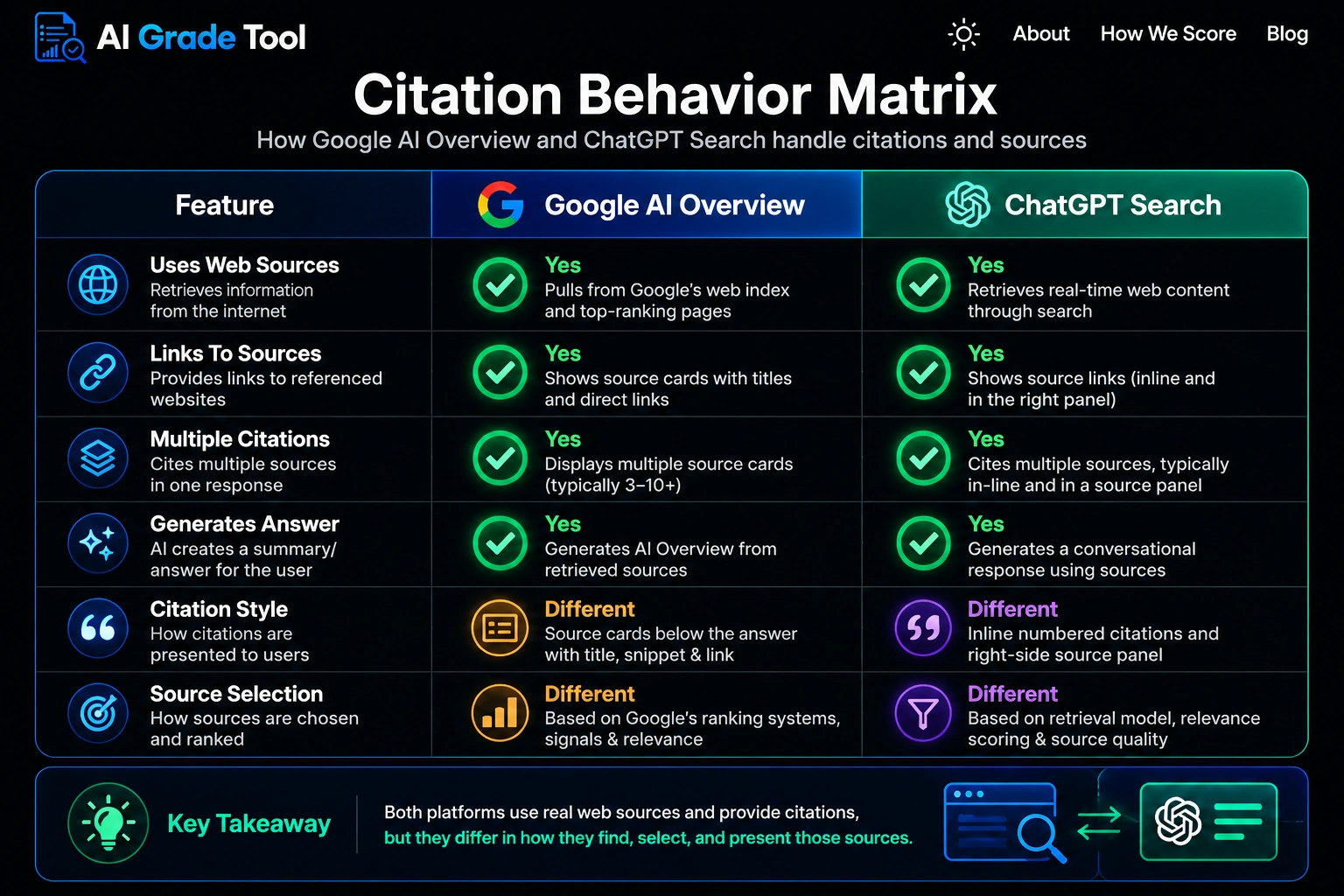 Citation behavior matrix comparing Google AI Overview and ChatGPT Search across the signals that matter most to publishers — query type, source signals, freshness sensitivity, and content style.
What publishers should do differently
The practical answer is not to create separate pages for every AI platform. Instead, publishers should build content that works well across systems while understanding that each platform may behave differently.
That usually means writing pages that answer real questions clearly, using descriptive headings, supporting claims carefully, maintaining topical depth, keeping important content crawlable, and updating pages when the underlying topic changes.
It also means avoiding lazy assumptions. Do not assume a high Google ranking guarantees a ChatGPT citation. Do not assume a ChatGPT citation means Google AI Overview will use the same page. Do not assume schema markup alone will fix weak content. Do not assume freshness matters equally for every query.
AI search visibility is not one thing. It is a set of overlapping discovery environments.
Questions People Still Ask
Can the same article be cited by both Google AI Overview and ChatGPT?
Yes, it can happen. A strong article that is crawlable, clear, and relevant may be useful across multiple AI search systems. But citation in one system does not guarantee citation in another.
Does ranking on Google help with Google AI Overview citations?
It may help because Google AI Overview exists inside Google Search and is influenced by Google’s broader search ecosystem. But AI Overview citations are not simply the same as ordinary organic rankings.
Does ChatGPT use Google’s search results?
ChatGPT’s search experience is separate from a normal Google results page. The source behavior depends on ChatGPT’s own search and retrieval experience, not on simply copying a Google ranking page.
Should I optimize differently for ChatGPT than for Google AI Overview?
The foundations are similar: write useful content, make it crawlable, structure it clearly, and build topical authority. The difference is that ChatGPT queries often sound more conversational, so content that answers natural questions clearly may be especially useful.
Is GEO replacing SEO?
No. GEO is better understood as an expansion of search strategy. Traditional SEO still matters, especially for crawlability, indexing, content quality, and authority. AI search adds another layer: whether your content is understandable and useful enough to be cited or synthesized by AI systems.
The difference matters, but the fundamentals still hold
Google AI Overview and ChatGPT do not cite websites the same way. They live in different products, serve different user behaviors, and present sources through different interfaces.
But the work publishers need to do is not completely separate. The strongest approach is to build content that is genuinely useful, clearly structured, technically accessible, and supported by topical authority. That gives your site a better chance across Google AI Overviews, ChatGPT, and the broader AI search landscape.
There will still be uncertainty. AI citation behavior is not fully transparent, and it will keep changing. But uncertainty is not a reason to wait. It is a reason to make your content easier to understand, easier to trust, and easier to cite.
You can see how a specific page currently scores for AI citation readiness by running it through AI Grade Tool — it measures extractability, structure, evidence density, and more.